
The Balance Sheet: What You Own, What You Owe, and Why It Matters
- tammyscarborough
- May 16, 2025
- 5 min read
Updated: Jul 6, 2025
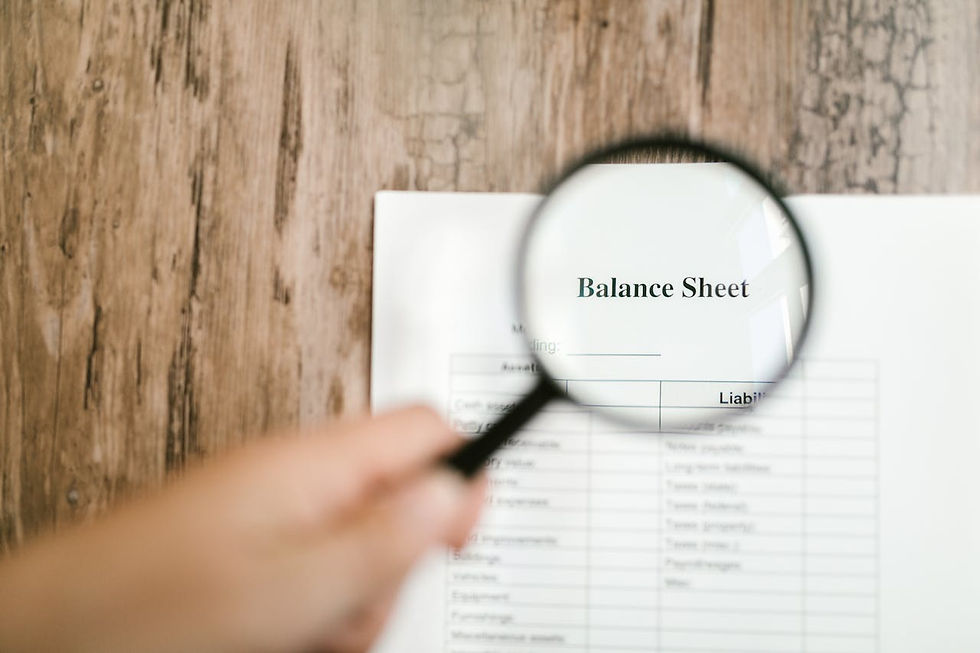
The Balance Sheet gives you more than numbers -- it reveals the true stability of your business.
Introduction
At Ledgers & Logic, we believe in building businesses that last. A key part of that longevity comes from financial clarity — and nothing offers a clearer snapshot of your business's current financial health than the Balance Sheet.
If you've ever searched "what is a balance sheet," "how to read a balance sheet," or "why do I need a balance sheet for my business," you're in the right place. This article breaks it all down in plain English so you can confidently understand and use your Balance Sheet to grow and protect your business.
While the Profit & Loss Statement shows you how your business is performing over time, the Balance Sheet shows you where your business stands right now. It's the difference between tracking your progress and checking your foundation. And that foundation matters, especially if you're thinking about sustainability, expansion, or the "going concern" of your company.
What Is a Balance Sheet?
The Balance Sheet is a financial statement that shows your business's assets, liabilities, and equity at a specific point in time. It answers three essential questions:
What do you own? (Assets)
What do you owe? (Liabilities)
What’s left over? (Equity)
The equation is simple:Assets = Liabilities + Equity
It might sound basic, but the insights are powerful. And importantly, the Balance Sheet must always balance — meaning your total assets must equal the sum of your liabilities and equity. If it doesn’t, something’s missing or misclassified.
Common examples of assets include cash, accounts receivable, inventory, equipment, vehicles, and real estate. Liabilities often include credit card balances, business loans, payroll liabilities, taxes payable, and accounts payable. Equity reflects the owner’s investment in the business and any retained earnings or losses.
Why It Matters: Your Business as a Going Concern
In accounting, the term "going concern" refers to a business's ability to continue operating for the foreseeable future. It’s not just about whether you made a profit this month — it’s about whether your business is financially healthy enough to survive and thrive.
The Balance Sheet plays a critical role in evaluating going concern because it highlights:
Liquidity: Can you cover your short-term obligations?
Solvency: Do your assets outweigh your liabilities?
Stability: Are you over-leveraged, or do you have a strong equity position?
These are the questions that lenders, investors, and even potential partners ask — and they all find their answers in your Balance Sheet.
How Financial Institutions Use the Balance Sheet
If you’re applying for a business loan or line of credit, your Balance Sheet becomes one of the first things a financial institution will review. Banks and lenders use the Balance Sheet to evaluate your financial health and risk profile. Specifically, they look at:
Current ratio (current assets ÷ current liabilities) — to measure your ability to repay short-term debt
Debt-to-equity ratio — to assess how leveraged your business is
Working capital — to understand how much liquidity you have on hand
Retained earnings and equity — to determine how much value you've built in the business
A strong, well-managed Balance Sheet can be the deciding factor in securing small business financing — and in negotiating better terms. It gives lenders confidence that your business is stable, responsible, and positioned for continued success.
What the Balance Sheet Tells You (That the P&L Doesn't)
While your P&L focuses on revenue and expenses over time, the Balance Sheet gives you:
A snapshot of how much cash is actually on hand
The current value of your receivables and inventory
How much debt you're carrying
Your current equity position (aka your net worth)
The financial strength of your business at any given moment
It's the statement that shows how well your business can weather a storm, capitalize on opportunities, or plan for long-term growth.
How Often Should You Review It?
You should be reviewing your Balance Sheet:
Monthly: To monitor cash flow, debt levels, and working capital
Quarterly: To assess financial position and trends
Annually: To prepare for strategic planning and tax filings
If your business is experiencing rapid growth, debt restructuring, or cash flow strain, you may want to review it even more frequently.
What to Watch For
When reviewing your Balance Sheet, pay attention to:
Cash & cash equivalents — Is there enough to cover short-term obligations?
Accounts receivable — Are customers paying on time?
Inventory — Is it moving or sitting?
Debt — Is it increasing faster than assets?
Equity — Are you building long-term value or staying flat?
Also, be aware of how your accounting method affects what you see. For example, if your business uses the cash basis of accounting, some important components like accounts receivable or accounts payable may not appear on your Balance Sheet. The accrual method provides a fuller picture of your financial position and is generally preferred when seeking outside funding or planning strategically.
And don’t forget: distributions or owner draws reduce equity. If you consistently take more out of your business than it earns, your Balance Sheet will reflect a declining equity position — even if you feel profitable day-to-day. Understanding this helps you protect the long-term value you're building.
Why This Matters for You
As a small business owner, your focus should be on the health and longevity of your company. And while it’s easy to get caught up in sales or monthly profits, your Balance Sheet shows whether your business is truly built to last.
Understanding your Balance Sheet:
Keeps you focused on building assets and reducing liabilities
Helps you make sound financial decisions
Signals when to expand — and when to pull back
Strengthens your position with lenders and investors
Reinforces the financial foundation that supports your vision
It’s not just a report — it’s your blueprint for sustainability and scalability.
At Ledgers & Logic, we help business owners do more than just track transactions.
We build systems that deliver clarity, consistency, and confidence in your numbers.
What We Do (In a Nutshell)
Ledgers & Logic helps small businesses:
Automate financial processes
Integrate AI-driven tools
Optimize accounting systems and tech stacks
Create real-time financial visibility
Build scalable financial infrastructure
Our Promise To You:
We build financial systems that are:
→ Smart enough to automate what can be automated
→ Flexible enough to evolve as you grow
→ Clear enough to give you financial peace of mind
Because the future of business is built on smart systems — and we’re here to help you lead the way.
Ready to Get a Clearer View of Your Business's Financial Strength?
Let’s talk about how Ledgers & Logic can help you design a smarter, more scalable financial operation.
Book Your Free Consultation Today



Comments